Visualising Atomic Orbitals Using Acoustic Standing Waves
1122 words · 6 min readAbstract #
This write-up details the design, construction, and theoretical rationale of my working model developed for my school science exhibition — where it secured first place in the grade 11 category. I also give a short break down of the its practical applications, accompanied by reference materials and illustrative diagrams. A full video breakdown will be available soon.
Introduction #
In the eyes of senior secondary students, the shapes and energies of the strange “atomic orbitals” they learn are assumed to be given facts, the reasons and intuitions of which they rarely encounter. They are expected to learn them as is, without understanding the deeper underlying principles that give rise to these mesmerising and mind-bending concepts.
This model aims to demystify the quantum-mechanical notion of atomic orbitals so that they can be intuitively explained, visualised, and rediscovered by high schoolers alike. Moreover, it demonstrates the beautiful connection between the physics of macroscopic classical wave mechanics and the subatomic quantum physics and chemistry of atomic orbitals.
This is done by starting with the understanding of the basic tenets on which atomic orbitals are based: (i) de Broglie’s wave-particle duality, i.e., the wave nature of electrons; and (ii) Heisenberg’s uncertainty principle, in this case, the probabilistic nature of electrons.
From the above principles, we deduce that an electron must be described by “probability waves”. However, these waves are not free — they are standing waves, because they are trapped due to the attraction/influence of the nucleus. The shapes of standing waves can be understood by producing physical acoustic waves. A string of a particular length and tension can be made to produce standing waves by an external force at the right “resonant frequencies”, demonstrated by the acoustic standing wave apparatus of this exhibit.
We can reason that, in the simplest case, the start and end of probability waves as one moves radially outward must be the nucleus and infinity, respectively. The nodes that form at various frequencies of standing waves (or various energy levels of electrons) in 1D represent “angular (planar)” and “radial” nodes in 3D. From the concept of radial probability, we obtain radial nodes. However, just as a node for a 1D wave is a point, for a 2D wave, it is a line, and for a 3D wave, it can be a plane. Hence, we can convert radial nodes into angular nodes for the same energy level.
From these, we obtain the various shapes of the basic orbitals 1s, 2s, 2p, 3s, 3p, and 3d.
Description #
Materials Used #
The model contains the following major parts with their materials:
- Acoustic Standing Wave Apparatus: 4″ 30W 4Ω subwoofer speaker driver, 7-8 cm lightweight metal nail, 4 toothpicks, 2-core copper speaker wire, 12V DC 2x30W 2.0 dual channel digital amplifier board, male DC power plug-connector, DC power source (12V 1500mAh 3S li-ion battery/12V 3A DC Power Adapter), aux cable, sine wave audio source (suitable frequency generator app on mobile), light and flexible thread (polyester crochet thread), G-clamp
- Models of Atomic Orbitals (1s to 3d): 20m of 14 gauge/2mm aluminium craft wire, corrugated cardboard, acrylic paint
- Base and Informative Boards: 3 cardboard sheets, chart paper, corrugated cardboard, acrylic paint
Construction and Working of the Model #
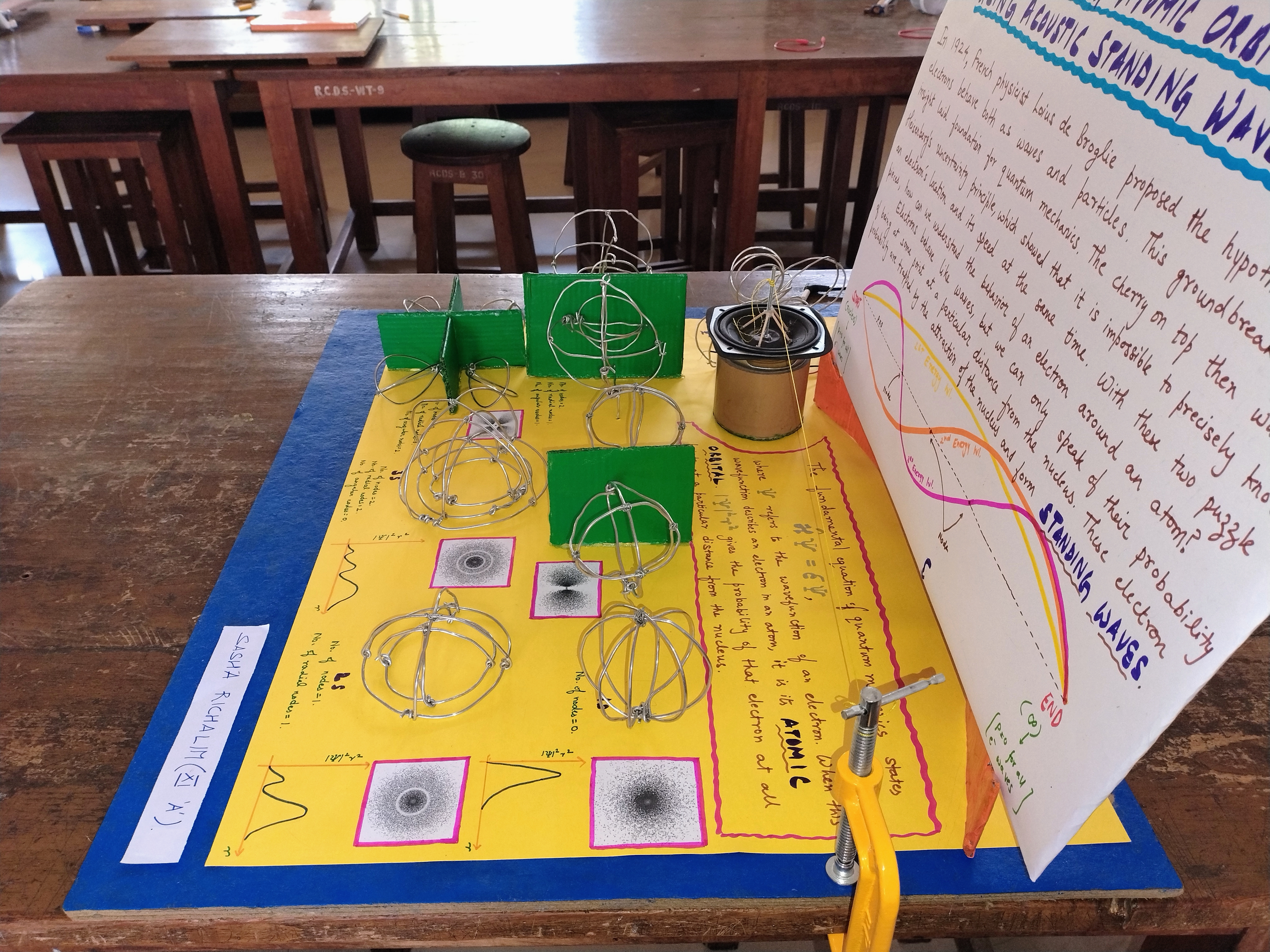
The model is built on top of a thick, glued-together cardboard base. It is painted, with chart paper stuck on top, which is meant to display the atomic orbital wire sculptures and their nodal surfaces, along with infographics (radial probability graphs, electron cloud diagrams, and a small description of the relation of Schrodinger’s equation with wave functions and orbitals).
The atomic orbitals are made by carefully bending and joining aluminium wires with pliers and wire cutters. These wire sculptures represent the boundary surface diagrams of atomic orbitals. In this manner, canonical orbital shapes (that is to say, only one orientation of each orbital) are displayed on the base by either being placed on top or tied through below the bottom of the base. The nodal planes for certain orbitals are indicated by small painted corrugated cardboard pieces attached to the base.
At the far back edge of the base is the acoustic wave apparatus. The 4-inch subwoofer is placed on top of the hollow part of the tape roll, within which a non-magnetic heavyweight is placed to prevent the woofer from moving. This woofer is connected via copper wires to the amplifier, which, in turn, connects to both the audio (a sine wave of adjustable frequency) and the DC power. On the dust cap of the subwoofer, a lightweight nail is glued, with toothpicks attached to it for support. Using a G-clamp placed on the edge opposite the speaker, the string is tied to the nail at an appropriately chosen arbitrary length and tension.
Behind the wave apparatus is a cardboard easel on which rests a board explaining the starting assumptions for intuitively bridging the analogy between a 1D standing wave and the 3D orbital shapes.
Applications #
- Pedagogical tool for science education: Serves as a powerful and interactive teaching aid for senior secondary science curricula, transforming abstract quantum theories into tangible, observable phenomena in front of students.
- Combating rote memorisation in competitive exam prep: Helps students move beyond blind memorisation of orbital shapes and nodal formulae by providing first-principles intuition.
- Lowering cognitive barriers in early science education: Eliminates the intimidation factor of quantum mechanics for high schoolers.
- Low-cost STEM education and resource optimisation: Demonstrates high-level scientific principles by using accessible, low-budget and easily repurposable components.
- Interdisciplinary bridge between physics and chemistry curricula: Unites classical wave mechanics of physics with atomic structure and electronic configurations taught in chemistry.
- Foundation for molecular bonding and hybridisation: Builds robust conceptual understanding in students before they advance into complex theories such as Molecular Orbital theory and VSEPR.
References #
FloatHeadPhysics. (2025, January 30). We finally understood orbital shapes intuitively! (My mind is blown) [Video]. YouTube. https://www.youtube.com/watch?v=M--6_0F62pQ
geoff martin. (2015, August 28). Modes on a String [Video]. YouTube. https://www.youtube.com/watch?v=cnH2ltfW48U
Mahan, B. M., & Myers, R. J. (1988). University chemistry (4th ed.). Addison-Wesley.
Acknowledgments #
I would like to extend my heartfelt thanks to Mahesh Shenoy (FloatHeadPhysics) for his intuitive and engaging breakdown of orbitals and quantum numbers, from which I drew central inspiration for this model. Creative educators like Mr. Shenoy bring immense clarity to complex physical concepts, breathing life into seemingly intangible abstract ideas. My gratitude also goes to Geoff Martin for his practical demonstration of generating standing waves acoustically. Lastly, I am deeply grateful to my physics and chemistry teachers and my family for their constant support, guidance, and encouragement throughout the model making and selection process.
Illustrations #
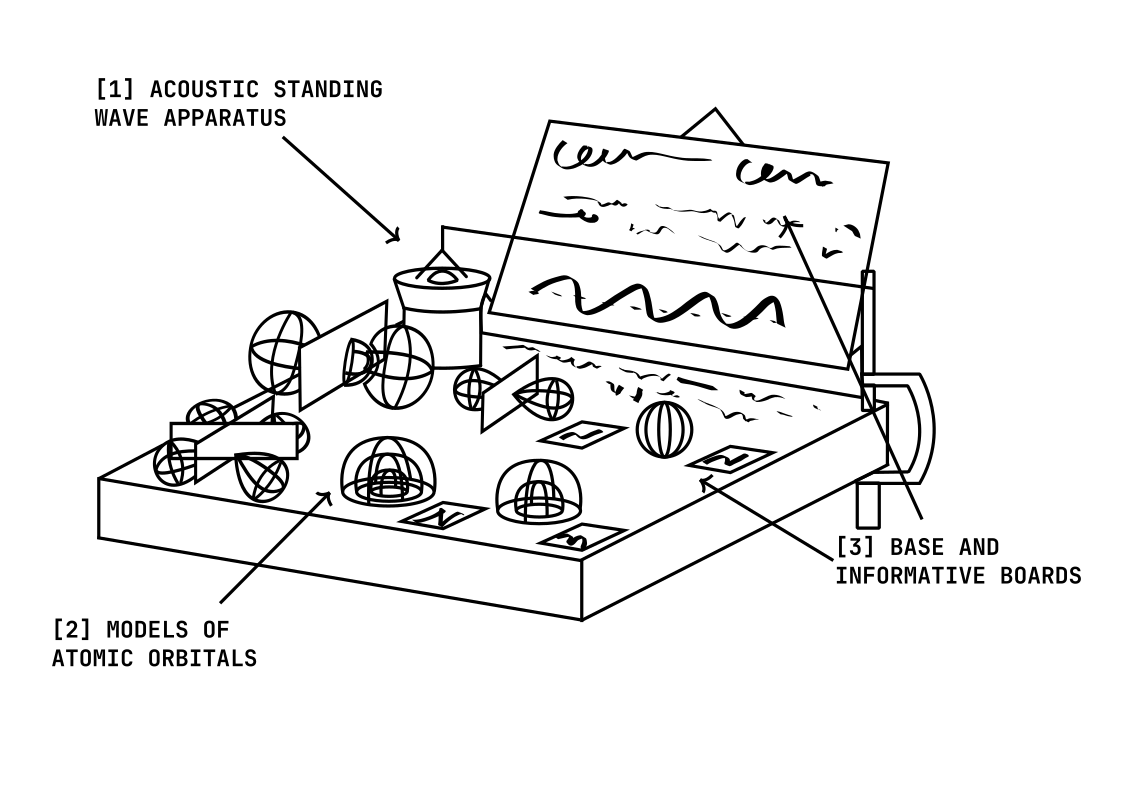
Black and white line diagram illustrating the model
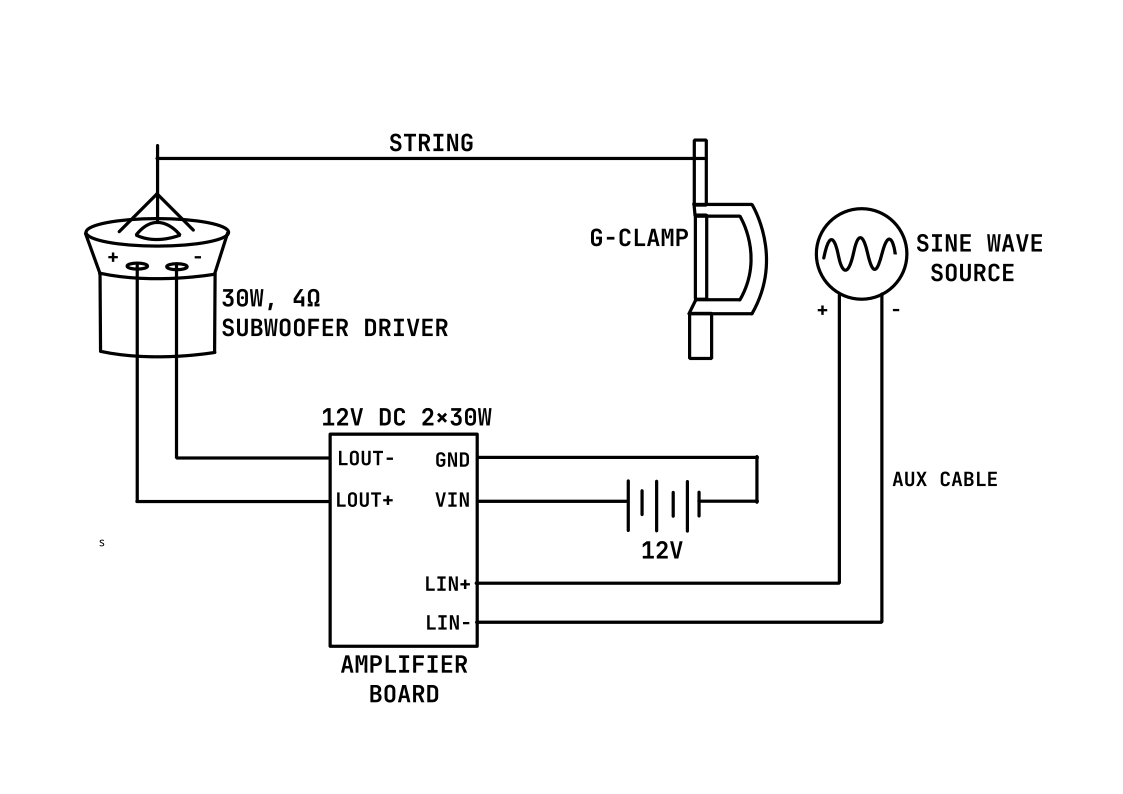
Black and white line diagram illustrating the wave apparatus
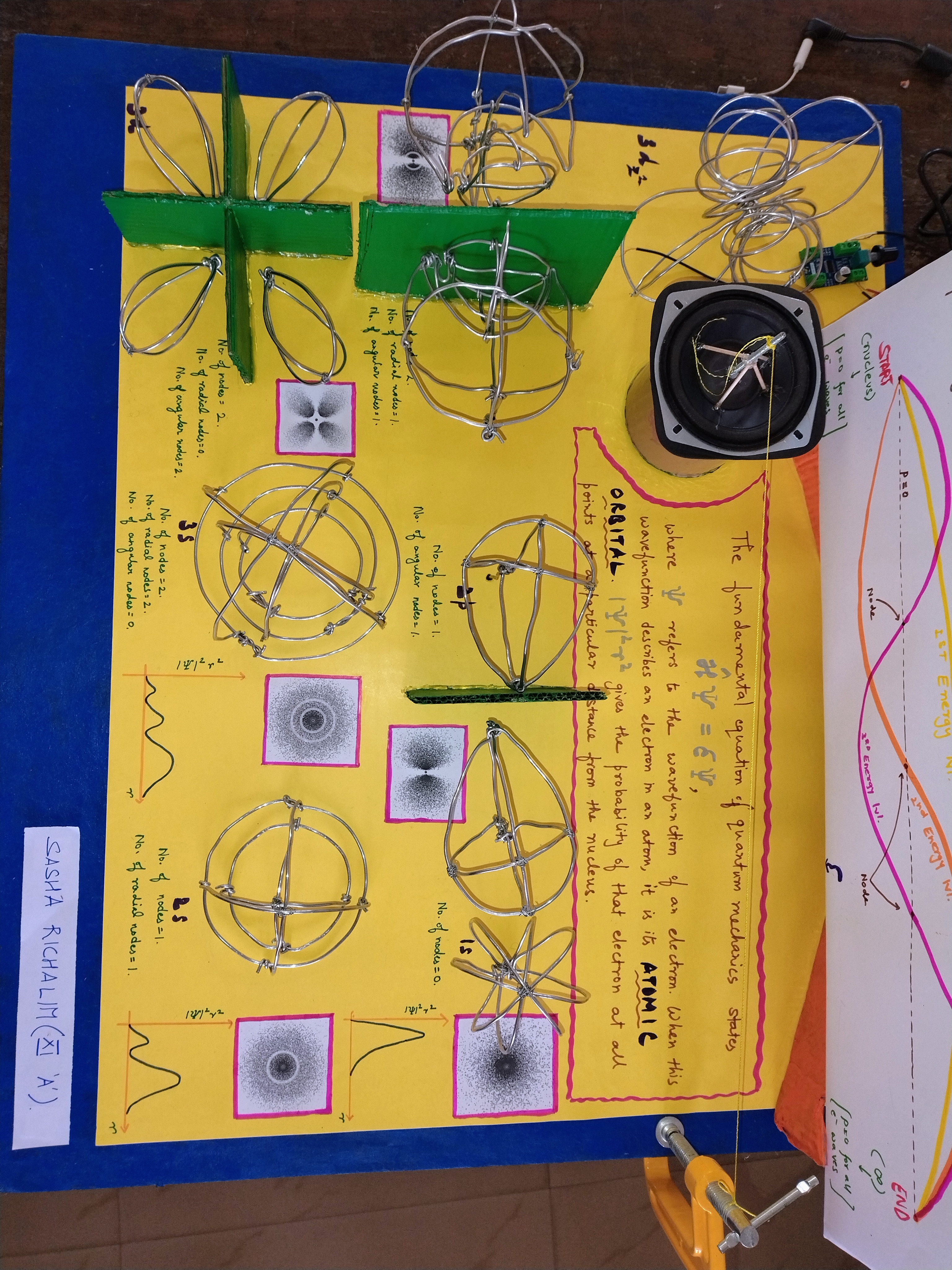
Above
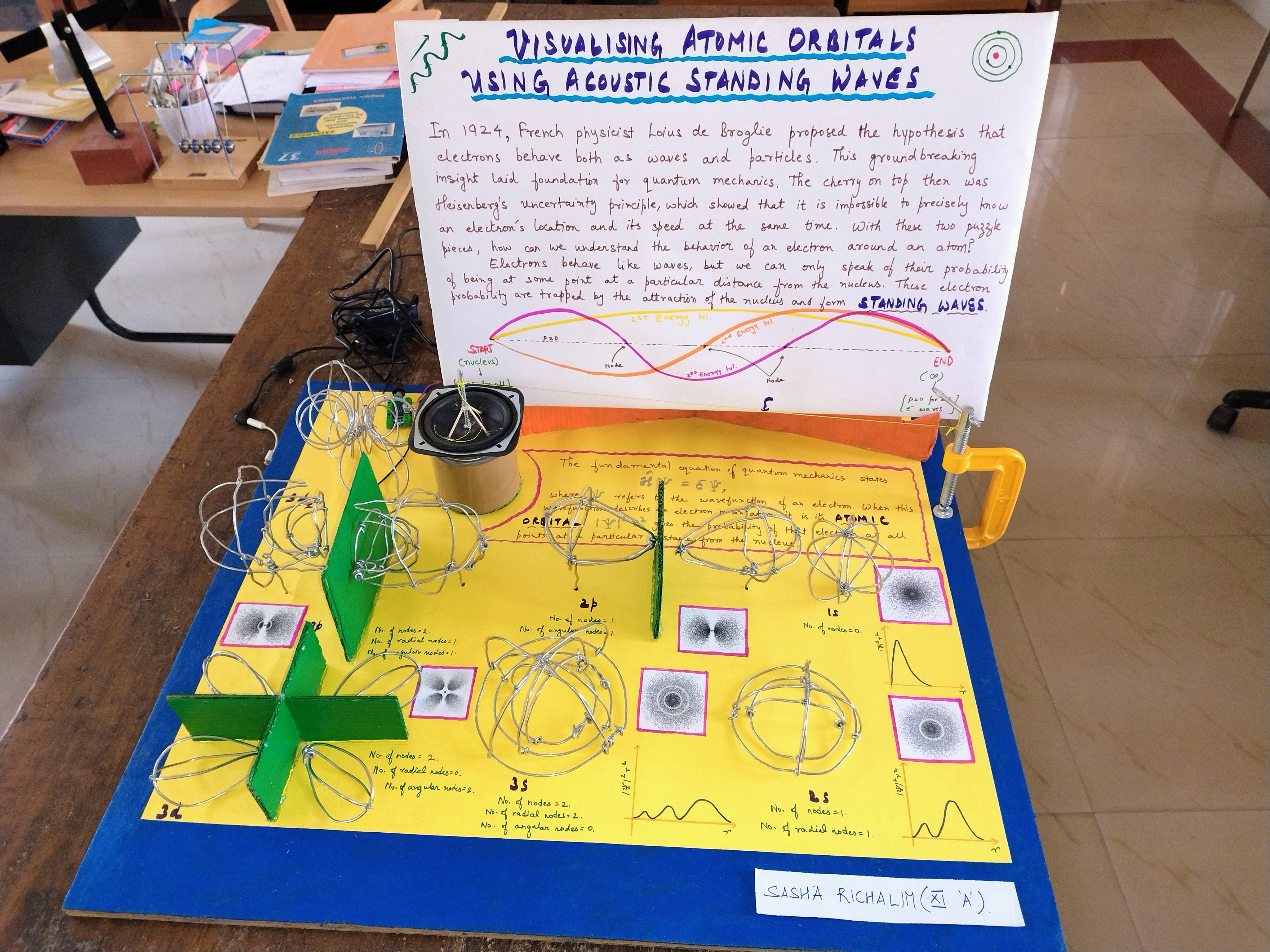
Front
Side
Thank you for reading! Found a mistake or want to get in touch? Feel free to drop me an email at src4026@proton.me. I'd love to hear from you!